

First policy brief released on sewer robotics and pollution prevention
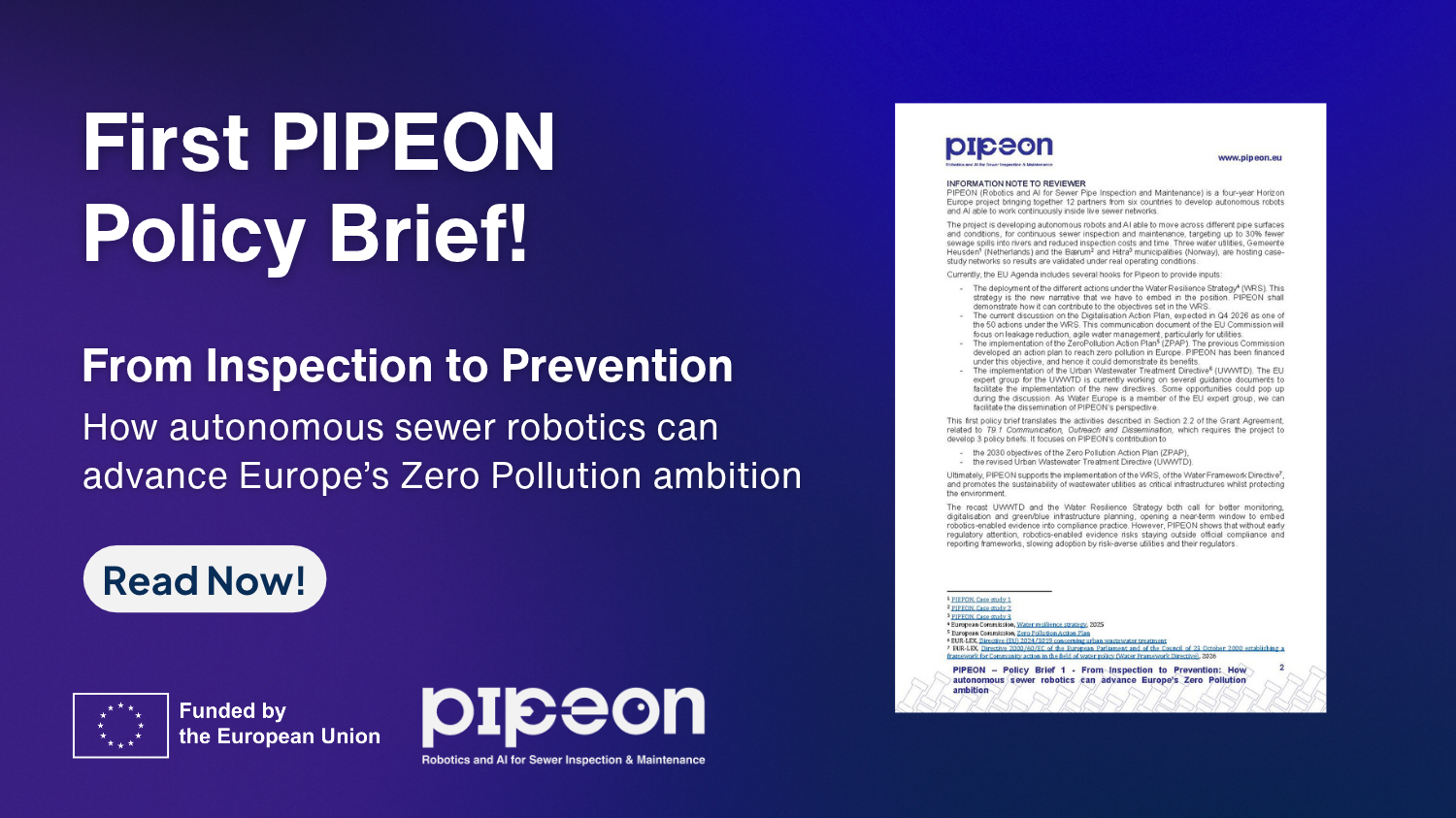
Six recommendations outline how EU policy can support autonomous inspection and preventive maintenance in wastewater networks.
PIPEON has released its first policy brief, From Inspection to Prevention: How autonomous sewer robotics can advance Europe’s Zero Pollution ambition. Authored by Water Europe, the publication sets out six recommendations for EU policymakers to support the uptake of autonomous sewer inspection and maintenance.
The brief examines how robots, sensors and artificial intelligence could help utilities identify defects and blockages earlier, prioritise maintenance and reduce the risk of untreated wastewater reaching the environment. It connects these opportunities with the implementation of the recast Urban Wastewater Treatment Directive, the Water Resilience Strategy and the EU’s Zero Pollution objectives.
Better information for preventive maintenance
Sewer defects and blockages can contribute to spills and flooding. Damaged pipes can also allow groundwater to enter sewer networks, increasing the volume transported and treated, or allow untreated wastewater to escape into surrounding soil and groundwater.
PIPEON is developing an integrated system combining autonomous robots, manipulators, sensors, AI and sewer-network models. By linking inspection findings with targeted interventions, the project aims to help utilities move towards more preventive, risk-based asset management.
The policy brief argues that adoption will also depend on regulatory recognition of inspection data, interoperability, investment support and clear safety and cybersecurity requirements.
Six recommendations for EU policymakers
- Recognise robotics and sensor-based condition data as valid evidence in Integrated Urban Wastewater Management Plans. Acceptance should depend on transparent methods, traceability and human oversight.
- Set common data and interoperability standards for AI-based sewer defect detection. Comparable defect codes, metadata, confidence scores and exchange formats would help utilities use results across systems.
- Embed autonomous inspection and predictive maintenance in the Water Resilience Strategy’s Digitalisation Action Plan. Smaller utilities should be included in testing, capacity-building and procurement guidance.
- De-risk early investment for utilities adopting robotics-enabled maintenance. Support should be linked to measurable performance, workforce transition, cybersecurity, interoperability and whole-life costs.
- Feed validated robotics-enabled evidence into the Zero Pollution Monitoring and Outlook framework. Project data should complement official environmental monitoring and help assess the contribution of preventive interventions.
- Clarify EU standards and regulatory requirements for innovative robotic solutions. Proportionate safety, cybersecurity and conformity-assessment requirements could help remove barriers for smaller utilities and innovative SMEs.
Testing the contribution to pollution prevention
PIPEON’s targets include a 30% reduction in sewage spills into rivers, at least 24 hours of autonomous operation, ten times more sewer distance inspected per day and a tenfold reduction in inspection costs. These are project targets to be assessed through staged laboratory and field validation.
The brief stresses the importance of tracing outcomes from defect detection through maintenance action to changes in network performance and pollution risk.


